About Françoise
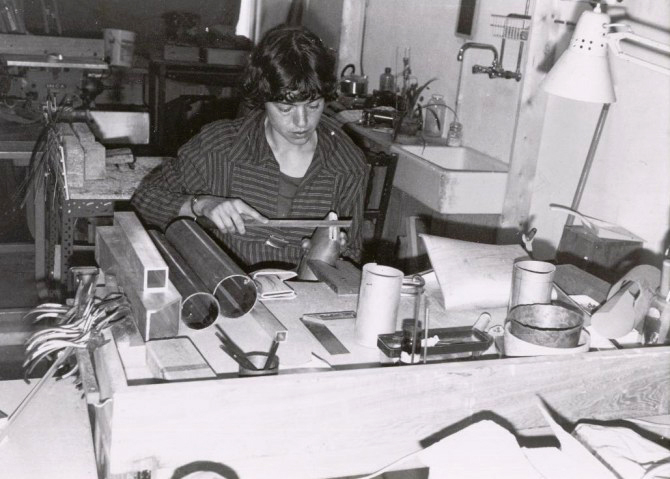
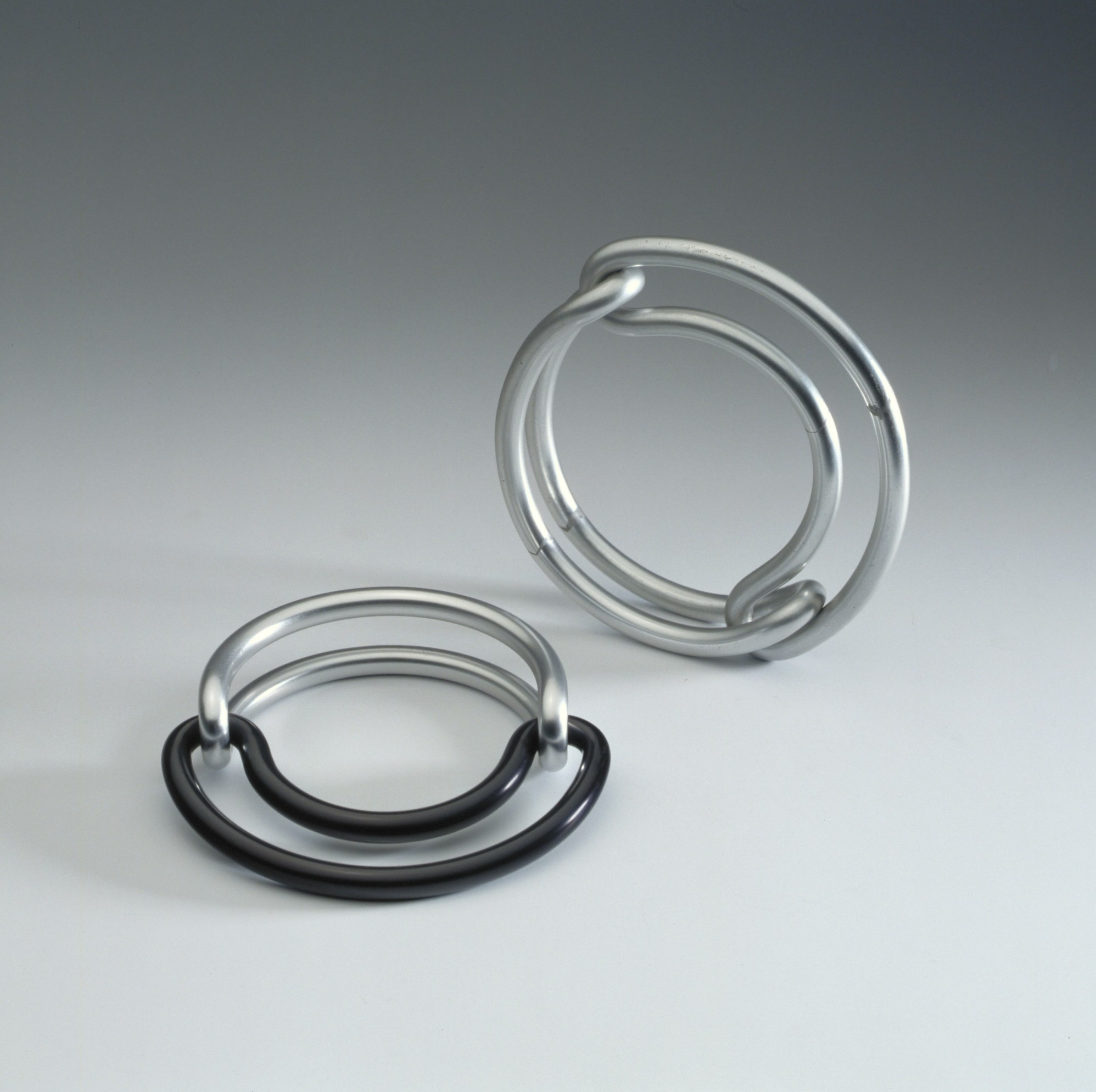
Françoise van den Bosch (1944–1977) was part of the first generation of innovators in the field of silversmithing. She was among the first jewellery designers, both in the Netherlands and internationally, to transition into creating autonomous objects. Many of these objects, like her jewellery designs, comprise of various components that can be slotted into each other. In her work the sculptural objects and the jewellery are in a constant interplay with each other.
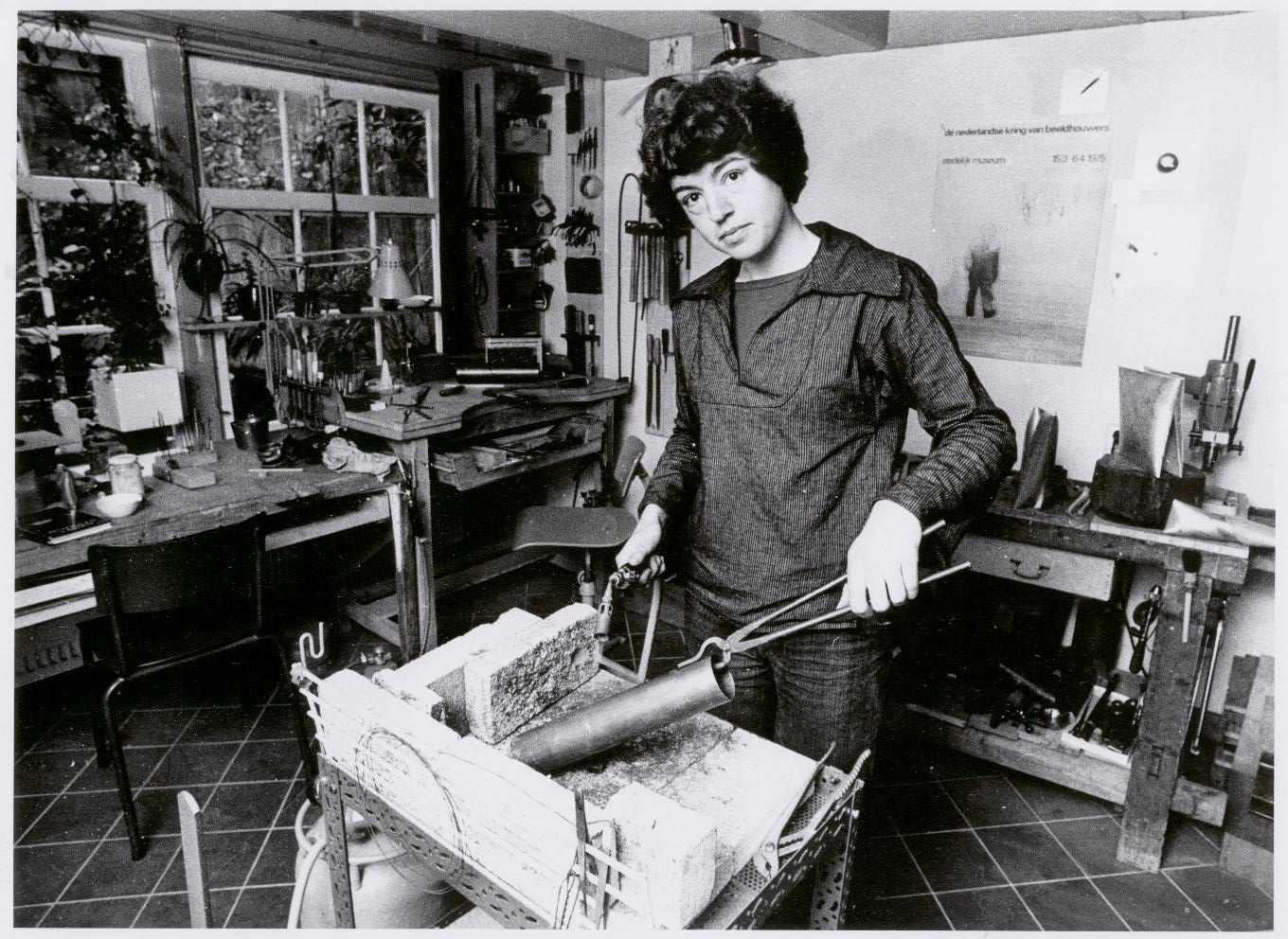
Françoise graduated in 1969 from the jewellery and silversmithing department at the art academy in Arnhem. The solid and ordered character of her work drew immediate attention of curators, collectors and art galleries.
Manner of working
Françoise van den Bosch worked directly with the material, using prefabricated steel, copper, and aluminum tubes. Her many small models and proofs, onto which she drew in felt-tip, show exactly how she developed her designs. Numerous examples of these can be found in the collection of the Françoise van den Bosch Foundation.
Research was essential to Françoise’s work. In an interview in the Amsterdam newspaper Parool of 13 May 1975, she explains: “I’ve always worked with metals. Metals are extremely hard, they challenge you. Metal reflects something, it is resilient, it also works against you and you can hurt yourself. I find it fascinating to explore all these characteristics”. And about her early period, after graduating from the Academy of Art, she says: “I cast off all those fixed associations and tried to discover new things. And not in the sense of: could that bracelet actually be worn”.
Figuration
In the collection of the Françoise van den Bosch Foundation are several early figurative objects by Françoise. While figurative art was not in keeping with the prevailing modernist art of the early seventies, for Françoise it was a way of giving concrete form to her ideas on life and on encapsulation and freedom. The circle, which she described as the ‘basic form of life’, was the starting point for these objects. They can be seen as personal expressions about her own growth and development. She did not enjoy showing these in public, but saved them for her own collection or gave them to her family. Despite their figurative aspect, these private objects, with their alternating spherical and concave forms and handling of the material, still bear an affinity to her ‘official’ abstract work.
Exhibitions
Her work was selected for the exhibition Objects to Wear by Five Dutch Jewellery Designers, which toured the Netherlands (Van Abbemuseum, Haags Gemeentemuseum, Museum Boijmans Van Beuningen) and the United States between 1969 and 1973. The jewellery of Emmy van Leersum, Gijs Bakker, Nicolaas van Beek, Bernhard Laméris, and Françoise van den Bosch was internationally promoted as a prime example of progressive Dutch jewellery design.
B.O.E. group
Along with Marion Herbst, Onno Boekhoudt, Karel Niehorster and Berend Peter, Françoise van den Bosch was one of the founding members in 1973 of the BOE group, the Union of Rebellious Silversmiths (Bond van Oproerige Edelsmeden). The B.O.E. group opposed the national acquisition policy of the time, which in practice benefited only a limited group of jewellery designers. They advocated for more transparency, greater public education, and improved exhibition and presentation opportunities for jewellery as an art form. Their first and only, but highly influential, exhibition Revolt in Jewellery by Five Dutch Artists took place in April 1974 at Electrum Gallery in London, by invitation of Ralph Turner.
Death
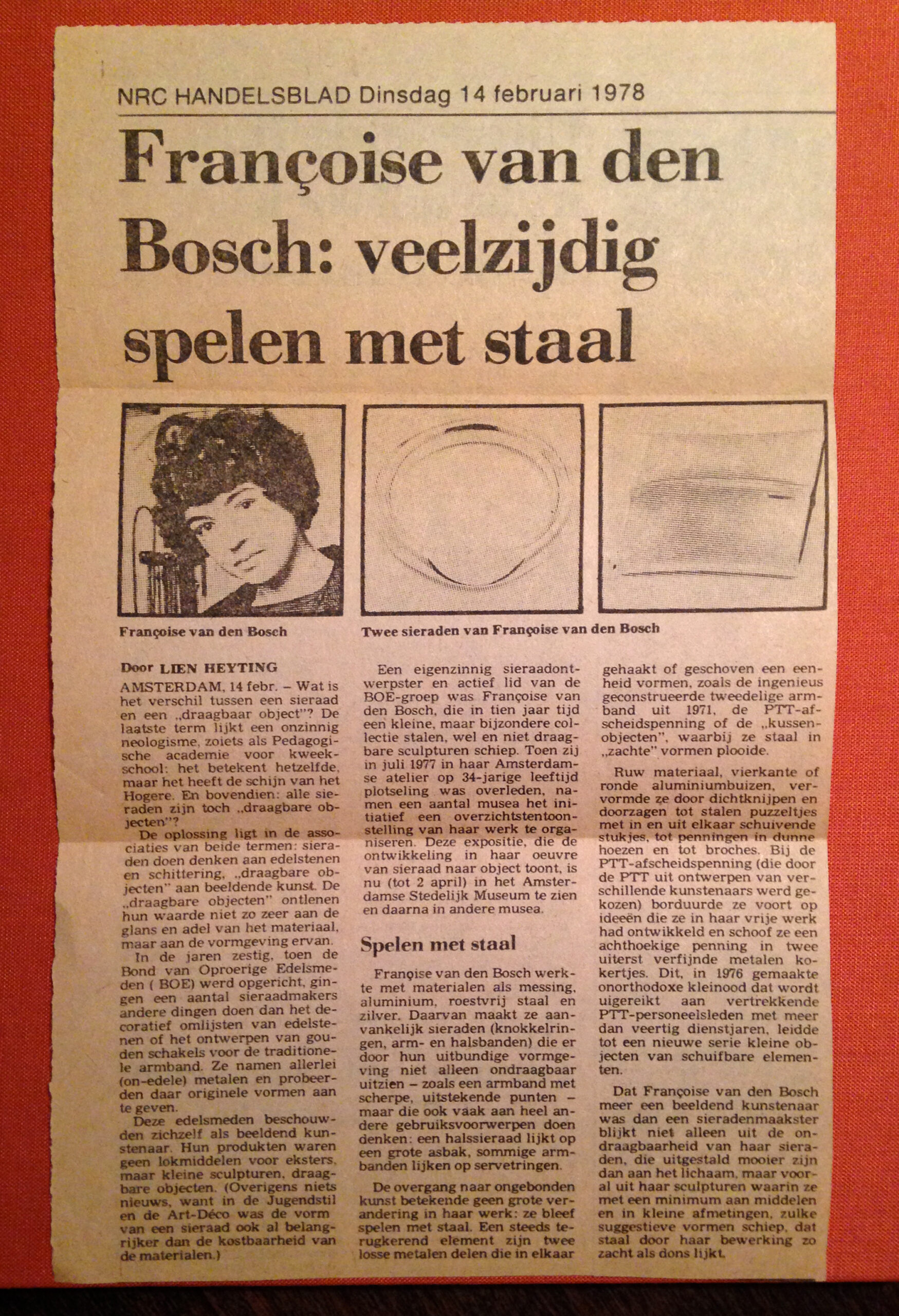
In July 1977 Françoise died unexpectedly aged thirty-three, at her house in Amsterdam. At the time she was preparing for a retrospective at the Van Reekummuseum, Apeldoorn. In 1978 and 1979 her show travelled to nine art galleries in the Netherlands, starting with the Stedelijk Museum, Amsterdam. The archive of Françoise van den Bosch is preserved at the RKD (Netherlands Institute for Art History) in The Hague.